Blog
How Does Truewell Work? Eleven Ingredients in One 600 mg Blend
Truewell works through its eleven ingredients, which sit together in one 600 mg blend. They fall into memory herbs, two B vitamins, eye pigments, cinnamon, green tea and salt. No single amount is printed, so how much each part adds is not listed on the label.
Written by the Truewell editorial teamMedically reviewed by Dr. Aimee Duffy, MD, PhysicianUpdated · 8 min read
Truewell
How is Truewell supposed to work?
As a mix. Each of the eleven ingredients is meant to add one small piece, and the capsule delivers them together once a day.
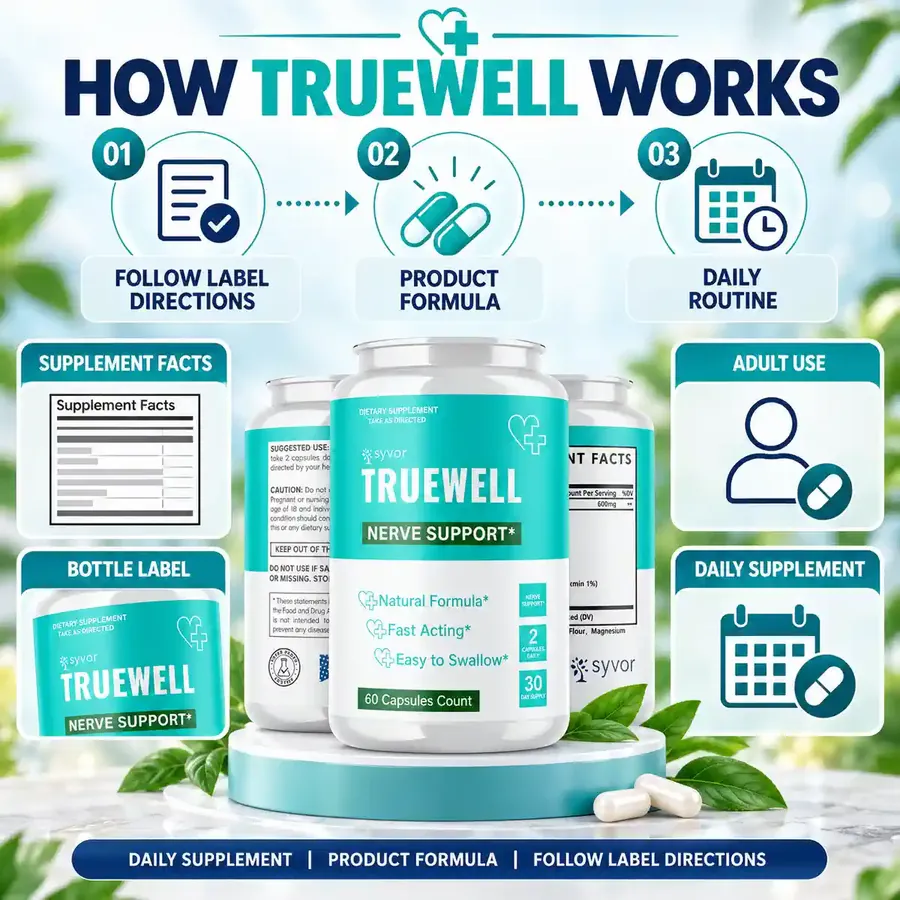
That is the brand's idea, shown in its graphic with three steps: follow label directions, take the product formula, keep a daily routine. The graphic names no ingredient, no dose and no time frame.
So there is no stated mechanism to check. What you can check is what each ingredient is known for when studied alone. The rest of this article does that, group by group, and keeps reminding you that the amounts are not printed.
The front of the bottle says Nerve Support*. The eBay listing calls it a nootropic for brain and nervous system health, and adds memory, focus and mood. So the aim is brain and nervous-system support, in the seller's words. Those are the goals. They are not findings.
Key facts
What are the key facts about how Truewell is built?
- One serving is 2 capsules. One bottle holds 30 servings.
- Each serving holds one proprietary blend of 600 mg that names eleven ingredients.
- Himalayan pink salt is listed first, so it weighs the most of the eleven. Green tea extract (50%) is last.
- Only vitamins B6 and B12 have a known link to nerves.
- The three memory-type ingredients are bacopa, alpha-GPC and ginkgo.
- No individual amount is printed, and no study of the blend has been published.
- Inactive ingredients are rice flour, magnesium stearate and silica dioxide.
Truewell
What do the memory ingredients do?
Bacopa monnieri is an Ayurvedic herb tested for memory. Many small trials found at least one small gain on some test, usually at about 300 mg a day for about 3 months (ADDF, Bacopa).
AGP choline is alpha-GPC, a choline compound. The research is in people with dementia, at 1,200 mg a day, and none is in healthy adults (ADDF, Alpha-GPC). Ginkgo is the best-known memory herb. Large studies, including one of 3,000+ adults aged 75 and older followed for about 6 years, found it did not lower dementia risk (NCCIH, Ginkgo).
Together they fit the listing's nootropic pitch more than the nerve bar on the label. The research behind them measured memory and thinking tests, not tingling.
Want to see the offer for yourself?If you want to see the exact pack, price and return terms behind this formula, the live listing shows them in writing.We earn money when you buy through our order links.
See today's price and guaranteeTruewell
What do vitamins B6 and B12 do in the blend?
Nerves need both vitamins. A shortage of B12 can cause numbness, tingling, balance problems and poor memory, and extra B12 helps people who are low (NIH ODS, Vitamin B12). The adult need is 2.4 mcg a day.
B6 is the tricky one. Adults need 1.3 to 1.7 mg a day, and a true shortage is uncommon. High supplement doses taken for a year or longer can cause severe nerve damage. The U.S. upper limit across all sources is 100 mg a day (NIH ODS, Vitamin B6).
Truewell prints no amount for either. So the blend could be a useful B12 top-up, a lot of B6, or something else. You cannot tell from the label, and the order desk is the place to ask.
Truewell
What are the eye pigments, cinnamon, green tea and salt doing there?
The brand does not say. Lutein and zeaxanthin are eye pigments from the AREDS2 eye formula, which uses 10 mg of lutein and 2 mg of zeaxanthin and is studied for macular degeneration (NEI, AREDS2). Bilberry here is the leaf, which may be unsafe at high doses or long term (NCCIH, Bilberry).
Research does not clearly support cinnamon for any condition (NCCIH, Cinnamon). Green tea extract brings caffeine, and rare liver injury has been reported with extract capsules (NCCIH, Green tea). Salt comes first on the list. Even if all 600 mg were salt, it would sit well below the 2,300 mg daily sodium limit (FDA, Sodium).
None of these has nerve or memory evidence in our sources. They may be there for reasons the brand has not shared.
Truewell
How much of each ingredient is in Truewell?
People search for Truewell 600 mg as if it were a dose. It is the total weight of the blend per serving. Nobody outside the company knows the split. A proprietary blend may show a total weight and list names from most to least by weight, without giving each dose (FDA, Labeling guide). That gives you one honest piece of arithmetic.
| Place | Ingredient | At most | Research amount for comparison |
|---|---|---|---|
| 1 | Himalayan pink salt | 600 mg | No nerve or memory study |
| 3 | AGP choline | 200 mg | 1,200 mg a day, dementia trials |
| 4 | Bacopa monnieri (20%) | 150 mg | Usually 300 mg a day |
| 7 | Vitamin B6 | About 86 mg | Need 1.3 to 1.7 mg a day |
| 8 | Ginkgo biloba powder | 75 mg | No standard dose in our source |
| 11 | Green tea extract (50%) | About 55 mg | No nerve or memory dose |
These are ceilings, not doses. All eleven share 600 mg, so the ceilings add up to far more than 600. The real amounts are lower, and by how much is not published.
Truewell
Why does a shared blend make Truewell hard to judge?
Because studies test a known amount. If a trial used 300 mg of bacopa, you can only compare a product that prints its bacopa amount. Truewell does not, and so you cannot.
The blend also hides the number that matters most in a nerve product: vitamin B6. If you take a multivitamin or a B-complex too, your total could rise without you knowing.
How many milligrams of B6 and B12 are in one serving? How much bacopa and alpha-GPC? Which material is the capsule shell? Call +1 (302) 200-3480 and keep the reply.
Truewell
What can the Truewell label claim, and what can it not?
A label may talk about supporting normal body function. It may not claim to treat or prevent a disease. That is why Nerve Support* carries a star that points to the FDA small print.
The FDA does not approve supplements before sale (FDA, Supplement Q&A). And the FTC expects claims about health to rest on solid science (FTC, Health claims). So you will not find words like heal, repair or reverse on the bottle, and you should not trust a page that uses them.
FAQ
Frequently asked questions
How does Truewell work?
Only through its ingredients, and the whole formula has never been tested. Bacopa, alpha-GPC and ginkgo are sold for memory. B6 and B12 are vitamins nerves need. Eye pigments, cinnamon, green tea and salt round out a 600 mg blend with no amounts printed.
Is there a clinical study on the Truewell formula?
No. We found no published trial of the blend. Studies exist for some ingredients alone, such as bacopa at about 300 mg a day for about 3 months, but Truewell does not say how much bacopa it holds.
What does the 600 mg mean on the Truewell label?
It is the total weight of the blend per serving of 2 capsules. Eleven ingredients share it. The label does not split it up, so the 600 mg tells you nothing about any single ingredient.
Why does a nerve formula include eye pigments?
The brand gives no reason. Lutein and zeaxanthin are known from eye research, and our sources make no nerve or memory claim for them. Bilberry has no clear benefit for any condition either.
Does Truewell contain caffeine?
Probably a little. Green tea extract contains caffeine and is the last ingredient, at most about 55 mg by label math. The caffeine amount is not printed. If caffeine bothers you, ask a pharmacist and take the capsules earlier in the day.
Can Truewell replace my nerve medicine?
No. It is a dietary supplement, not a treatment. Keep taking prescribed medicine, and ask your doctor before adding any supplement. Do not stop or alter a dose by yourself.
What are the 11 ingredients in Truewell?
They fall into groups: memory herbs, vitamins B6 and B12, eye pigments, cinnamon, green tea extract and salt. All share one 600 mg blend, and the label does not print a separate amount for each.
Is the Truewell blend tested as a whole?
No study of the full blend has been published. Individual ingredients have their own studies, but the label hides every amount, so those results cannot be applied directly to this product.
What groups of ingredients are in Truewell?
Truewell’s eleven ingredients fall into memory herbs, two B vitamins, eye pigments, cinnamon, green tea and salt. All of them share one 600 mg blend.
Our view
Our view
Our view is that Truewell works the way any blend works: through what is in it, at the amounts inside it. Here, the first part is printed and the second is not.
That makes the formula easy to read and hard to judge. You can learn what each ingredient is. You cannot learn how much you get. Ask for the numbers that matter to you, B6 most of all, and count it with everything else you take.
We earn money when you order through our links, so we try to say what we do not know right next to what we do.
Truewell is a dietary supplement for adults. It is not a drug, not FDA approved and not meant to treat or prevent any disease. Check with a doctor or pharmacist first if you take a blood thinner, nadolol, thyroid medicine, seizure medicine, theophylline or cycloserine, or if you have liver disease or surgery planned. Pregnant or nursing mothers should consult a physician.
Sources
- Bacopa monnieri: Cognitive Vitality. Alzheimer's Drug Discovery Foundation, 2026.
- Alpha-GPC (choline alfoscerate): Cognitive Vitality. Alzheimer's Drug Discovery Foundation, 2026.
- Ginkgo. National Center for Complementary and Integrative Health, 2026.
- Vitamin B12: Fact Sheet for Consumers. NIH Office of Dietary Supplements, 2026.
- Vitamin B6: Fact Sheet for Consumers. NIH Office of Dietary Supplements, 2026.
- Nutritional Supplements for Age-Related Macular Degeneration. National Eye Institute, 2026.
- Bilberry. National Center for Complementary and Integrative Health, 2026.
- Cinnamon. National Center for Complementary and Integrative Health, 2026.
- Green Tea. National Center for Complementary and Integrative Health, 2026.
- Sodium in Your Diet. U.S. Food and Drug Administration, 2026.
- Dietary Supplement Labeling Guide: Chapter IV. Nutrition Labeling. U.S. Food and Drug Administration, 2005.
- Questions and Answers on Dietary Supplements. U.S. Food and Drug Administration, 2026.
- Health Products Compliance Guidance. Federal Trade Commission, 2022.
Last updated . Read our editorial standards. This website is run by a U.S. retailer that sells Truewell, not by the manufacturer (the label says distributed by Syvor LLC, Salisbury, NC). We earn money when you buy through our order links.
Keep reading
- How it works page
- All 11 ingredients
- Supplement Facts
- Vitamin B6 profile
- Memory herbs in nerve formulas
- How to choose a nerve supplement
Last updated November 20, 2026. Review date: October 16, 2026. Medically reviewed by Dr. Aimee Duffy, MD, Physician.
See the offer behind the formula
The listing is the one place that shows the pack size, the price and the return terms in the seller's own words. Open it when you are ready, and compare it with the label.
See today's price and guaranteeWe earn money when you buy through our order links. The final total, shipping and return terms show on the live listing before you pay.